
Ice-blink — Collaged engravings cut from first editions of Elisha Kent Kane’s Arctic Explorations (1856), dipped in iodine
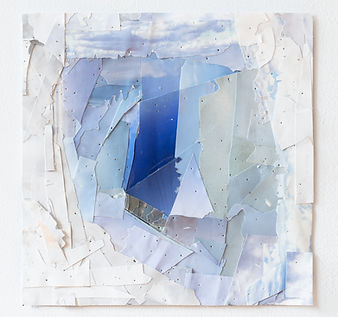

Open Polar Sea — Collage Sculptures and floor works from engravings cut from first editions of Elisha Kent Kane’s Arctic Explorations (1856)
Atlas of Air — Pigment prints on rice paper, collaged from the empty spaces, often air and sky, in New York Times front-page photographs

Untitled Times — A 21-foot continuous scroll of cut and collaged New York Times fragments, made over nearly a decade

Ghosts in — CMYK screenprinted paintings and assemblages from the cut-up New York Times, made in dialogue with Thomas Jefferson’s cut-and-pasted Bible (1820)

Within the Faint Positive — Unfixed photograms collaged with permanent ink, made while retracing a 19th-century botanist’s plant-hunting route through China; when exhibited, the photographic images disappear and the ink remains

Barnard Objects — Photographic fragments from American history books, physically cut and reconfigured after E. E. Barnard’s photographic atlas of the Milky Way
What they would have edited out (if they could) — Unedited audio recording of the artist humming along to Glenn Gould’s humming, in real time, through his 1981 Goldberg Variations

Night Vision — Large-scale abstracted reliefs after a found photograph of the Hindu Kush, built from inkjet printouts of night-vision photographs taken by American soldiers in Afghanistan

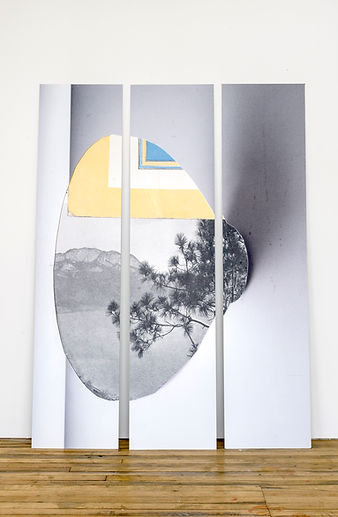
No One Came to Meet Me — UV prints on Dibond, reworked from Joseph Francis Rock’s 1924–25 National Geographic photographs of the Tibet–China borderlands, images that helped seed the Western myth of Shangri-La
Self must have a certain width — Collages interleaving photographic prints of the 1893 Chicago World’s Fair with New York Times images, and words from the title in plexiglass letters
.jpg)
Phenomena of Materialization — Large-scale collages reassembling the séance photographs in Schrenck-Notzing’s Phenomena of Materialization (1914) into drips, stains, and blots

Times from mid-February to mid-July — Collage of New York Times margins cut over six months, laid down week by week, left to right, like a letter

The New World — Collages and drawings from archival images, centered on a twenty-foot panorama cut from a single 1892 book, Glimpses of the World by John Stoddard